
An indoor infrared sauna can turn an ordinary room into a private wellness space, but owning one is about more than choosing a beautiful wooden cabin and plugging it in.
Size, electrical requirements, installation, heating performance, comfort, maintenance, and everyday convenience all matter. For homeowners considering a two-person infrared sauna, understanding what ownership is actually like can make the difference between a smart investment and an expensive piece of equipment that rarely gets used.
Here is what to consider before bringing an infrared sauna into your home.
A Sauna Can Become Part of Your Everyday Routine
One of the biggest advantages of having a sauna at home is convenience.
Instead of driving to a gym, spa, or wellness center, the sauna is available whenever you want it. A well-designed indoor model can become part of an evening routine, a morning ritual, or a relaxing way to finish a workout.
Modern infrared saunas can also offer features that make regular use easier. Temperature controls, lighting, built-in audio, and scheduling capabilities can turn a sauna session into a more personalized experience.
The real value is not necessarily one individual feature. It is the ability to create a consistent wellness routine without leaving home.
How Much Space Does an Indoor Sauna Need?
A two-person sauna may sound compact, but these units can be surprisingly substantial once fully assembled.
Before purchasing one, measure more than the floor footprint. Consider:
-
Ceiling height
-
Doorway dimensions
-
Hallways and turns
-
Staircases
-
Door swing
-
Clearance around the sauna
-
The final location of the electrical connection
One important detail is that individual panels may be easier to move through a doorway than the completed sauna itself. That means the installation route needs to be considered before assembly begins.
A finished basement, home gym, large bedroom, or dedicated wellness room can work particularly well. The goal should not simply be finding a space where the sauna technically fits. You want enough surrounding room for comfortable access and everyday use.
Electrical Requirements Should Be Checked Before Ordering
Electrical requirements are one of the easiest things to overlook.
A sauna that operates on a standard household voltage may still require a dedicated circuit and a specific outlet configuration. That means you should not assume that an existing wall outlet will automatically be suitable.
Before ordering an indoor sauna, confirm the manufacturer's electrical specifications and compare them with the electrical setup in your intended room.
If the required circuit is not already available, an electrician may need to prepare the space.
Planning this before delivery can prevent delays and unexpected installation costs.
Delivery and Assembly Are Part of the Ownership Experience
A large sauna is not comparable to receiving a small piece of furniture.
Wooden panels and glass components can be heavy, awkward, and difficult to maneuver. Even when the assembly itself is relatively straightforward, moving the components into position can be the hardest part.
For many two-person infrared saunas, having two capable adults available is a practical minimum for assembly. Professional installation can be worthwhile when the delivery route involves stairs, narrow hallways, tight corners, or finished surfaces that could easily be damaged.
If you decide to assemble the sauna yourself, take your time. Careful alignment is important, particularly when working with large panels and glass components.
Design Matters More Than You Might Expect
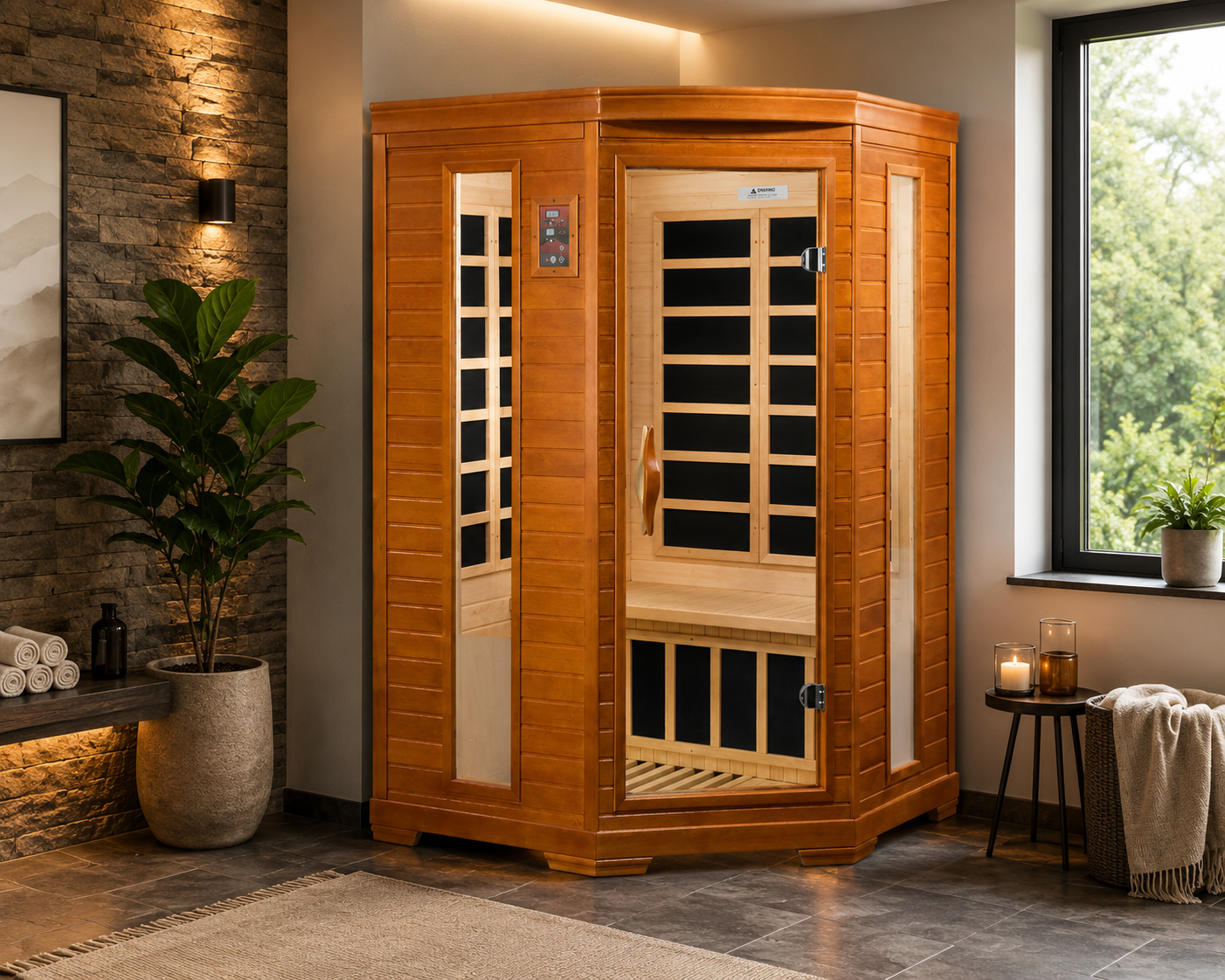
An indoor sauna does not have to look like a bulky wooden box placed in the corner of a room.
Contemporary designs increasingly combine natural wood, large glass panels, clean lines, integrated lighting, and discreet technology. This makes the sauna feel more like a piece of modern interior architecture than traditional gym equipment.
A glass door can also make the cabin feel more open. Instead of creating a dark, enclosed environment, the transparent surface allows the sauna to visually connect with the surrounding room.
Natural wood adds warmth, while integrated controls and lighting can keep the overall appearance clean and uncluttered.
For homeowners who care about interior design, appearance can be an important part of the buying decision.
What Does Infrared Heat Feel Like?
Infrared heat can feel noticeably different from the intense heat of a traditional sauna.
Rather than immediately filling the cabin with extremely hot air, infrared heating creates a gentler sensation that gradually builds during a session. Many people describe it as a more direct, penetrating warmth.
That can make infrared saunas appealing to people who enjoy the relaxing experience of heat but find very high traditional-sauna temperatures overwhelming.
The important point is that temperature numbers should not be the only way to compare sauna experiences. Two saunas can have different heating technologies and maximum temperatures while producing very different sensations.
How Long Does an Infrared Sauna Take to Heat?
Preheating time depends on the sauna, room temperature, electrical configuration, and other factors.
A modern infrared sauna may need a period of preheating before reaching its desired operating temperature. For people with busy schedules, this can make scheduling features particularly useful.
Instead of waiting for the sauna to warm up after finishing work or exercising, you can plan ahead and have the cabin ready when you are.
That small convenience can make a significant difference in how frequently the sauna is actually used.
Is a Two-Person Sauna Comfortable?
A properly designed two-person sauna should provide enough room for two adults to sit comfortably without feeling excessively cramped.
However, dimensions matter.
Pay attention to the bench length, interior height, backrest design, and available shoulder space. A sauna marketed for two people is not necessarily equally comfortable for every pair of users.
A reclined or ergonomically shaped backrest can make a noticeable difference during longer sessions. Instead of sitting rigidly upright, users can lean back and relax.
For couples, friends, or family members who plan to use the sauna together, interior comfort should be considered just as carefully as exterior dimensions.
Smart Features Can Make a Sauna Easier to Use
Technology is increasingly becoming part of the modern sauna experience.
Depending on the model, features may include:
-
App-based controls
-
Temperature adjustment
-
Scheduled heating
-
Interior lighting
-
Chromotherapy or ambient lighting
-
Bluetooth audio
-
Integrated speakers
Of these features, scheduling may be one of the most practical.
Being able to prepare the sauna before you need it removes one of the small barriers that can prevent people from using it regularly.
Audio and lighting are more about creating an atmosphere. For some homeowners they will be essential; for others, the simplicity of a quiet sauna will be preferable.
Maintenance Is Relatively Simple, But It Still Matters
An indoor sauna generally does not require complicated maintenance, but regular care helps preserve the wood and interior surfaces.
Using towels on benches and backrests can reduce direct contact with sweat and make cleaning easier. After a session, removing damp towels and allowing the interior to dry can also help keep the cabin fresh.
Glass doors may require frequent cleaning because fingerprints and moisture are especially visible on transparent surfaces.
The best approach is simple: clean the sauna regularly, follow the manufacturer's care recommendations, and use cleaning products that are appropriate for the specific wood and finish.
How Much Electricity Does an Infrared Sauna Use?
Running cost is an important question for anyone considering an indoor sauna.
Actual electricity consumption depends on the sauna's power requirements, session length, frequency of use, local electricity rates, and how long the unit spends heating.
For that reason, a single estimated monthly figure should not be treated as universal.
A homeowner using a sauna several times per week for relatively short sessions will have a different energy cost from someone using it every day for longer periods.
The easiest way to estimate your own cost is to combine the sauna's power consumption with your local electricity rate and expected usage.
The Biggest Advantage: Convenience
The strongest argument for an indoor infrared sauna is often not its maximum temperature, speaker system, lighting, or appearance.
It is convenience.
When the sauna is already inside your home, using it requires considerably less effort. There is no commute, no membership, and no need to plan a trip around a spa's opening hours.
That accessibility can make it easier to establish a consistent routine.
A sauna that is used regularly is far more valuable than one that simply looks impressive.
What Should You Consider Before Buying?
Before purchasing an indoor infrared sauna, think about the entire ownership experience rather than focusing only on the advertised features.
Ask yourself:
Do I have enough space?
Measure the room and the complete route from the delivery point to the final installation location.
Is the electrical system suitable?
Check the required voltage, circuit, amperage, and outlet configuration.
Will I need professional installation?
Consider the weight of the components and whether stairs or tight spaces make installation difficult.
Will two people actually use it?
If the sauna will normally be used alone, a one-person model may be more appropriate. If couples will use it together, prioritize interior comfort.
Do I want technology?
Decide whether app controls, scheduling, speakers, and lighting genuinely add value to your routine.
How often will I use it?
This may be the most important question of all. The best sauna is one that fits naturally into your lifestyle.
Final Thoughts
An indoor infrared sauna can be much more than a home appliance. With the right design and placement, it can become a dedicated space for slowing down, relaxing, and creating a consistent wellness routine.
But buying one requires more planning than simply choosing a model you like.
Measure the room. Check the electrical requirements. Think about delivery and installation. Consider who will use it and how often. Then look at comfort, heating performance, design, technology, and maintenance.
For homeowners who have the space and intend to use the sauna regularly, an indoor infrared model can transform an unused corner of the home into a private wellness retreat—without requiring a major renovation.