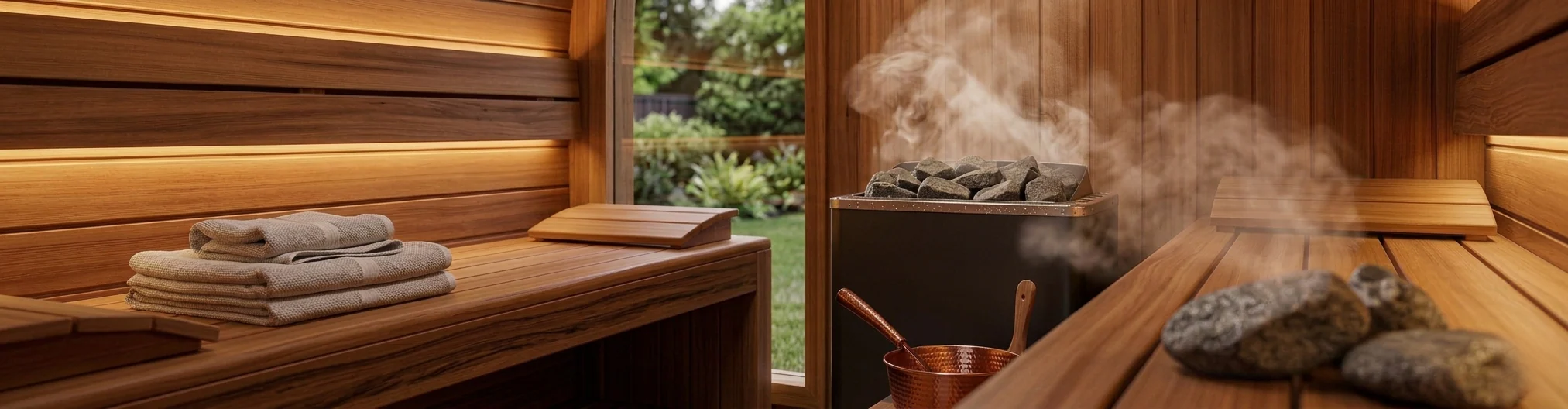
What happens when you step into the heat after exercise? Learn what research says about recovery, muscle soreness, endurance, relaxation and the safest way to add sauna to your training routine.

Quick answer
A sauna after exercise can be a useful recovery and heat-acclimation tool, but it is not a substitute for sleep, hydration, nutrition or rest. Research suggests possible benefits for perceived recovery, muscle soreness and, with repeated post-exercise heat exposure, some measures of endurance performance and heat tolerance.
One important point
Most research on post-workout sauna involves traditional hot saunas. There is also promising evidence from a small study of infrared sauna after resistance exercise.
The evidence is encouraging, but it is still not strong enough to say that every sauna routine will improve recovery or performance.
What Are the Benefits of Sauna After a Workout?
| Potential benefit | What research suggests | Evidence |
|---|---|---|
| Relaxation | Heat exposure may help reduce stress and promote a relaxed feeling after exercise. | Reasonable |
| Muscle soreness | A 2023 study found less subjective muscle soreness after a single infrared sauna session following resistance exercise. | Promising, limited studies |
| Perceived recovery | The same infrared sauna study found higher perceived recovery the following day. | Promising |
| Heat acclimation | Repeated post-exercise sauna sessions can improve thermoregulatory responses in trained runners. | Good evidence in endurance athletes |
| Endurance performance | Small studies have reported improvements after several weeks of post-exercise sauna use, although results are not uniform. | Promising but mixed |
| Cardiovascular stimulus | Sauna raises heart rate and causes blood vessels to dilate, creating a cardiovascular heat stress. | Strong physiological basis |
| Immediate hydration | Sauna causes sweating and fluid loss. It does not hydrate you. | Important caution |
| Fat loss | Short-term weight changes after sauna are primarily water loss, not body-fat loss. | Do not confuse water loss with fat loss |
Why Use a Sauna After Exercise?
Exercise already raises your body temperature and heart rate. A sauna adds another controlled heat stimulus after your workout.
When you enter a hot sauna, your body responds by increasing skin blood flow and sweating. Your heart rate can rise as your cardiovascular system works to move warm blood toward the skin so heat can escape.
That response is one reason researchers are interested in sauna as a form of passive heat exposure. Instead of exercising harder, you are adding heat stress while sitting and recovering.
Exercise + heat creates a larger thermal challenge.
The combination can stimulate adaptations involved in sweating, circulation and temperature regulation. However, more heat is not automatically better. The goal is a manageable heat stimulus, not extreme dehydration.
1. Sauna May Help You Feel More Recovered
One of the most interesting studies on this topic looked specifically at infrared sauna after resistance exercise.
Researchers studied 16 male basketball players who completed a demanding resistance and plyometric exercise session. After exercise, participants either rested passively for 20 minutes or spent 20 minutes in an infrared sauna at approximately 43°C (109°F). The trials were randomized and separated by one week.
The researchers found that the infrared sauna condition reduced the drop in countermovement-jump performance, reduced subjective muscle soreness and increased perceived recovery.
Basketball players
Trained male basketball players participated in the randomized crossover study.
Infrared session
The post-exercise infrared sauna exposure lasted 20 minutes.
Sauna temperature
The infrared sauna averaged approximately 43°C, with some variation.
Promising does not mean universal.
This was a small study involving trained male basketball players and a single post-exercise session. It provides useful evidence that infrared sauna may influence short-term recovery, but it does not prove the same effect for every person, workout or sauna type.
2. Sauna May Reduce the Feeling of Muscle Soreness
Heat has long been used as a comfort strategy for tired or sore muscles. Sauna adds whole-body heat rather than applying heat to only one area.
The infrared sauna study found lower subjective muscle soreness after resistance exercise compared with passive recovery. This is encouraging, but researchers still need larger trials to determine how consistent the effect is.
It is also important to separate feeling less sore from recovering faster biologically. A person may feel better without every marker of muscle damage returning to normal faster.
3. Sauna Can Support Heat Acclimation
This is one of the better-supported performance applications of post-exercise sauna use, particularly in endurance athletes.
In a study of 20 trained middle-distance runners, participants added approximately 28 minutes of sauna bathing after exercise about three times per week for three weeks. The sauna group improved several measures of heat tolerance and also showed improvements in VO₂max and running speed at a standardized blood-lactate concentration compared with training alone.
Repeated post-exercise sauna exposure appears capable of producing useful heat-acclimation adaptations, including lower heart rate and lower body temperature responses during subsequent heat stress.
This is particularly relevant for athletes who need to compete or train in hot environments. It is less clear whether the same routine provides a meaningful performance boost for recreational gym users training in normal temperatures.
4. Sauna May Support Endurance Training Adaptations
There is a long-standing interest in using sauna after endurance training to increase blood volume and improve tolerance to heat.
A small 2007 crossover study of six competitive male distance runners found that three weeks of post-training sauna bathing increased plasma volume and improved treadmill time-to-exhaustion performance. The authors suggested that expanded blood volume may have contributed to the performance improvement.
More recent research has also found improvements in trained runners after several weeks of post-exercise sauna exposure.
Sauna immediately after every hard workout is not automatically better.
A randomized study of 20 competitive swimmers and triathletes found that a sauna session after an intensive workout actually worsened next-morning swim performance compared with passive recovery. The researchers advised caution when another high-intensity session or competition is scheduled the next day.
5. Sauna Can Be a Useful Relaxation Ritual
Not every benefit needs to be measured on a stopwatch.
Many people find heat exposure relaxing after training. Sitting quietly in a warm environment can provide a transition between intense exercise and the rest of the day. Cleveland Clinic notes that sauna use may help reduce stress and soothe sore muscles.
If sauna helps you unwind, that may make it easier to build a consistent recovery routine. The key is not to mistake relaxation for proof of a specific physiological effect.
6. Sauna Creates a Cardiovascular Heat Stimulus
Sauna increases heart rate and causes blood vessels near the skin to dilate. This creates a cardiovascular response even though you are sitting rather than exercising.
Researchers have studied whether repeated sauna exposure can contribute to cardiovascular adaptations. A randomized controlled trial involving 47 adults with cardiovascular risk factors compared exercise alone with exercise plus 15 minutes of post-exercise sauna for eight weeks. The study found additional improvements in some cardiovascular measures in the combined exercise-and-sauna group, although exercise itself remained an important component.
This is an important distinction: sauna can complement exercise, but it should not be treated as a replacement for exercise.
7. Sauna Does Not Replace Hydration
This is probably the most important point for anyone using a sauna after training.
You have already lost fluid through exercise. Sauna adds additional sweating. If you enter the sauna significantly dehydrated and stay too long, you increase the risk of dizziness, headache, weakness and heat-related illness.
Do not use the scale immediately after a sauna as proof that you have burned a large amount of fat. A sudden drop in body weight is largely a reflection of fluid loss.
Sweat loss is not fat loss.
If you weigh less after a workout and sauna, you have most likely lost water. Once you replace those fluids, much of that weight returns. Sustainable fat loss comes from long-term energy balance and training, not from dehydration.
Traditional Sauna vs. Infrared Sauna After a Workout
| Feature | Traditional sauna | Infrared sauna |
|---|---|---|
| Typical temperature | Often around 150–195°F (66–91°C) | Often around 110–135°F (43–57°C) |
| Primary heat method | Heats the surrounding air and body through heat transfer | Uses infrared radiation to heat the body more directly |
| Post-workout research | Larger research base, especially for endurance and heat acclimation | Smaller research base, including a promising 2023 recovery study |
| Comfort | Hotter and more intense for many people | Lower air temperature may feel more comfortable |
| Recovery evidence | Mixed depending on timing and workout intensity | Promising short-term findings, but more studies are needed |
When Is the Best Time to Use a Sauna After a Workout?
There is no single scientifically established “perfect” timing for every athlete.
For general wellness, many people prefer sauna after the workout once their breathing and heart rate have started to settle. Give yourself time to cool down, drink fluids and assess how you feel before entering the sauna.
For normal gym or strength training
A short, comfortable session may be reasonable if you are well hydrated and feel recovered enough to tolerate additional heat.
For endurance training
Repeated post-exercise sauna exposure may be useful when the goal is heat acclimation. This is where the research is particularly interesting.
Before another hard training session
Be more cautious. If you have a demanding workout or competition the next day, additional heat stress may not improve performance and could leave you dehydrated or fatigued.
How Long Should You Stay in a Sauna After a Workout?
There is no universal evidence-based duration that works for everyone.
Research protocols vary considerably. Some studies have used roughly 15 minutes, while endurance studies have used around 28–31 minutes or repeated sauna bouts. These research protocols should not be interpreted as instructions for everyone.
For a recreational user, a conservative approach is sensible: start with a short session, see how your body responds and leave if you feel unwell.
A sensible routine
✓ Finish your workout
✓ Cool down gradually
✓ Drink fluids
✓ Enter the sauna comfortably hydrated
✓ Start with a short session
✓ Cool down and rehydrate afterward
Signs to stop
✕ Dizziness
✕ Nausea
✕ Unusual weakness
✕ Feeling faint
✕ Confusion
✕ Difficulty breathing or chest symptoms
What Medical Experts Say About Sauna Use
Cleveland Clinic's Dr. Amy Zack discusses sauna use as a possible way to reduce stress, support cardiovascular health, relieve pain and soothe sore muscles. She also emphasizes that sauna is not appropriate for everyone and that hydration and safe exposure matter.
The practical message is simple: sauna can be part of a healthy routine, but it should complement, not replace, the fundamentals of recovery.
What the Research Does Not Prove
It is easy to turn promising sauna studies into exaggerated fitness claims. The evidence does not prove that sauna after every workout:
✕ Builds muscle directly
✕ Burns significant amounts of body fat
✕ Eliminates all muscle soreness
✕ Guarantees better performance the next day
✕ Replaces sleep or nutrition
✕ Produces the same results for every athlete
The strongest evidence is more specific: repeated heat exposure can produce heat-acclimation adaptations, and some studies suggest improvements in perceived recovery and selected performance measures. Other studies show that sauna immediately after very intense exercise can sometimes hurt next-day performance.
Who Should Be More Careful?
Sauna is not appropriate for everyone. People with certain heart conditions, uncontrolled blood pressure, conditions affecting heat tolerance, or those taking medications that alter hydration or blood pressure should speak with a healthcare professional before sauna use.
Do not use a sauna when you are already significantly dehydrated, acutely ill or feeling faint. Avoid combining sauna with alcohol because alcohol can increase dehydration and cardiovascular stress.
Stop if you feel unwell.
Sauna should feel challenging but controlled. Dizziness, nausea, confusion, faintness, unusual weakness, chest symptoms or significant breathing difficulty are reasons to leave the sauna and seek appropriate medical help if symptoms are serious or persistent.
So, Is Sauna After a Workout Worth It?
The Bottom Line
For many healthy adults, sauna can be a useful addition to a workout recovery routine. The strongest research-based reasons to use it are relaxation, a possible reduction in perceived muscle soreness, and repeated heat exposure for heat acclimation and certain endurance adaptations.
But sauna is not a shortcut around the basics. Hydration, adequate food, sleep, sensible training and rest remain much more important. And if you have another hard session or competition the next day, more heat is not necessarily better.
Frequently Asked Questions
Is sauna good after a workout?
It can be. Research suggests potential benefits for relaxation, perceived recovery, muscle soreness and heat acclimation. The effects depend on the workout, sauna type, duration, hydration and the individual's response.
Does sauna help muscle recovery?
Some evidence suggests it may improve perceived recovery and reduce subjective muscle soreness. A small 2023 study found promising results after a single infrared sauna session following resistance exercise. Larger studies are still needed.
Does sauna after a workout build muscle?
There is no good evidence that sauna directly builds muscle. Resistance training, adequate protein and calories, progressive overload and recovery are the main factors driving muscle growth.
Does sauna after exercise burn fat?
Sauna causes sweating and temporary water-weight loss. That is not the same as burning body fat. Any meaningful fat loss comes from sustained changes in energy balance and lifestyle.
Can sauna improve endurance?
Repeated post-exercise sauna exposure has improved some endurance and heat-tolerance measures in small studies of trained runners. This appears particularly useful as a heat-acclimation strategy, but results are not guaranteed.
Should I sauna after every workout?
Not necessarily. You may not need additional heat after every session, especially after very intense workouts or when you are already dehydrated. Your training schedule and recovery status should guide the decision.
How long should I stay in a sauna after exercise?
There is no universal duration. Research protocols vary, and beginners should start conservatively. Hydration and how you feel are more important than trying to reach a specific time.
Is infrared sauna good after weight training?
There is promising evidence. A small randomized crossover study in male basketball players found that 20 minutes of infrared sauna after resistance exercise was associated with less soreness, higher perceived recovery and a smaller decline in explosive performance the next day.
Should I drink water before sauna after a workout?
Yes. Exercise and sauna both increase fluid loss. Rehydrate after exercise and avoid entering the sauna significantly dehydrated.
Can sauna after a workout make recovery worse?
It can in some circumstances. A study of competitive swimmers and triathletes found worse next-morning swimming performance after post-exercise sauna following an intensive training session. Additional heat stress is not always beneficial.