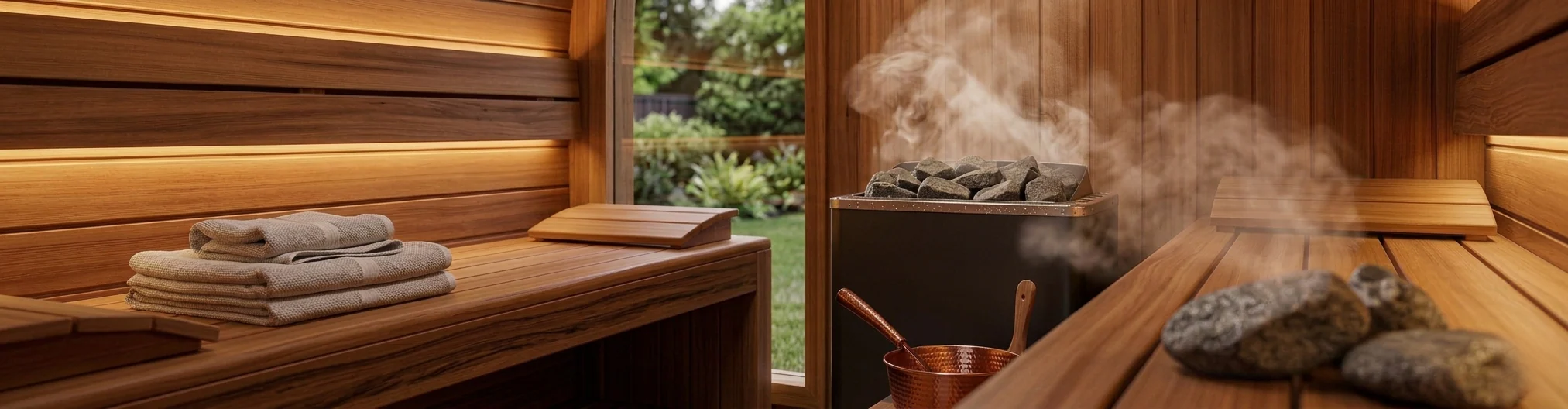
Two different ways to experience heat. One heats the air; the other uses infrared energy. Here’s what doctors, medical organizations, and scientific research actually tell us.

Quick answer
There is no universal winner. Traditional Finnish sauna has the stronger and longer research history, especially for observational cardiovascular research. Infrared sauna operates at lower temperatures and may be more comfortable for people who dislike intense heat.
The biggest difference
Traditional sauna: heats the surrounding air, which then warms your body.
Infrared sauna: uses infrared radiation to transfer heat to the body more directly, allowing a lower room temperature.
Infrared vs. Traditional Sauna at a Glance
| Feature | Infrared Sauna | Traditional Sauna |
|---|---|---|
| Heating method | Infrared radiant energy | Heated air, usually with a sauna heater and stones |
| Typical temperature | About 110–135°F (43–57°C) | Often about 150–195°F (66–91°C) |
| Heat sensation | Lower ambient temperature; radiant warmth | Hotter surrounding air |
| Humidity | Usually low | Usually low, with steam bursts possible when water is added to stones |
| Research history | Growing, but more limited | Extensive Finnish sauna literature |
| Best fit | People who prefer gentler heat | People who want the classic high-heat sauna experience |
How Does a Traditional Sauna Work?
A traditional sauna—often associated with Finnish sauna bathing—uses a heater to raise the temperature of the room. The heated air transfers warmth to your skin and body. Sauna stones can store heat, and in many traditional saunas water can be poured over the stones to create a burst of humidity.
The result is an intense heat environment. Your body responds by increasing blood flow to the skin and producing sweat as it works to regulate temperature.
Traditional sauna has the deeper research base.
A major review in Mayo Clinic Proceedings examined epidemiological, experimental, and clinical evidence concerning Finnish sauna bathing. The literature includes interesting associations between frequent sauna use and cardiovascular outcomes, but observational associations should not be treated as proof that sauna itself caused those outcomes.
How Does an Infrared Sauna Work?
Infrared saunas use infrared heaters that emit radiant energy. Instead of relying primarily on very hot air, the system transfers heat more directly to the body.
Because the surrounding air does not need to reach traditional-sauna temperatures, infrared rooms commonly operate around 110–135°F (43–57°C). Mayo Clinic notes that infrared saunas can produce sweating and an increased heart rate at lower temperatures than conventional saunas.
Cleveland Clinic’s discussion of infrared saunas explains that infrared systems use a different heating method and can create sauna-like heat exposure at lower temperatures.
Why it matters: a lower thermometer reading does not necessarily mean the sauna experience is insignificant. Infrared heat can still make the body warm and trigger sweating.
What Happens to Your Body During Sauna Use?
Heat exposure causes a number of short-term physiological responses. Blood vessels near the skin can dilate, heart rate can rise, blood flow to the skin can increase, and sweating helps regulate body temperature.
These responses help explain why sauna bathing can feel physically demanding even though you are sitting still. But passive heat exposure is not the same as exercise and should not be marketed as a replacement for physical activity.
Harvard Health’s discussion of sauna research emphasizes an important distinction: observational studies have linked frequent sauna use with cardiovascular outcomes, but researchers are still working to determine whether sauna use itself causes those long-term benefits.
In plain English: a connection in a population study is interesting, but it is not the same as a clinical trial proving cause and effect.
Which Sauna Has Better Scientific Evidence?
If your decision is based primarily on the depth of the research literature, traditional sauna currently has the advantage.
Finnish sauna bathing has been investigated in large observational cohorts and scientific reviews for years. Infrared sauna therapy has also been studied, including clinical research, but the evidence base is smaller and many claims need further investigation.
More research does not automatically mean “better.”
Traditional sauna has more published evidence because it has a long history of widespread use and research. That does not prove that traditional sauna is superior to infrared in every health outcome. It simply means we currently have a deeper evidence base for traditional sauna bathing.
What Does Research Say About Infrared Sauna?
Infrared sauna therapy has been studied in cardiovascular and rehabilitation contexts. One systematic review and meta-analysis examined sauna therapy in people with heart failure and found short-term improvements in some cardiac measurements after infrared sauna therapy. However, the authors rated the evidence from moderate to insufficient in different areas and called for more research into long-term effects.
That means the responsible conclusion is not “infrared sauna treats heart failure.” Instead, the evidence suggests that infrared sauna therapy is a legitimate subject of clinical research, with some promising findings that require further confirmation.
Is Infrared Sauna Better Because It Uses Lower Temperatures?
Lower temperature can be a significant advantage for comfort, but it does not automatically make infrared sauna healthier.
For someone who finds a 175°F traditional sauna overwhelming, a lower-temperature infrared sauna may be much easier to tolerate. That can make it easier to incorporate sauna use into a routine.
Ultimately, the best sauna is partly the one you can use comfortably and safely rather than the one with the highest number on the thermometer.
Which Sauna Is Better for Relaxation?
This is mostly personal preference.
Traditional sauna users often enjoy the intense heat, wood interior, sauna stones, and classic Finnish atmosphere. Infrared sauna users may prefer the gentler radiant warmth and lower ambient temperature.
Infrared may suit you if…
✓ You dislike extreme heat
✓ You prefer a lower-temperature environment
✓ You want a gentler heat experience
✓ You are looking for a modern home-sauna format
Traditional may suit you if…
✓ You love intense heat
✓ You want the classic Finnish experience
✓ You enjoy sauna stones and humidity bursts
✓ You value the deeper traditional-sauna research history
Does Sauna Use Burn Fat?
Be careful with this claim. A sauna can cause temporary weight loss because you lose water through sweating. That is not the same as losing body fat.
Sauna use should therefore not be presented as a replacement for exercise, nutrition, or an appropriate calorie balance. Cleveland Clinic specifically cautions against treating sauna use as a weight-loss strategy.
Does an Infrared Sauna “Detox” Your Body?
Sweating is primarily a temperature-regulation mechanism. Your liver and kidneys play major roles in processing and eliminating waste from the body.
For that reason, strong claims that infrared saunas dramatically “detox” the body go beyond what high-quality evidence currently establishes. A more credible wellness article should describe sweating and heat exposure without turning them into unsupported detox promises.
The honest verdict
Traditional sauna wins on research history. Infrared sauna wins for many people on comfort and lower ambient temperature.
Neither should be presented as a miracle therapy. The best choice depends on the experience you want, your tolerance for heat, and your individual circumstances.
Sauna Safety: What Should You Know?
Heat exposure is not appropriate for everyone. Sweating can lead to fluid loss, and some people may experience dizziness, lightheadedness, low blood pressure, or overheating.
Harvard Health advises caution for people with certain heart conditions or low blood pressure and recommends paying attention to symptoms. Hydration is important because sauna sessions increase fluid loss through sweating.
If you feel dizzy, weak, nauseated, unusually short of breath, or excessively overheated, leave the sauna and cool down.
If you have a cardiovascular condition, take medications that affect blood pressure or fluid balance, are pregnant, or have another condition that may affect your ability to tolerate heat, discuss sauna use with a qualified healthcare professional.
So, Which Sauna Is Actually Better?
Choose traditional sauna if you want the classic high-temperature Finnish experience and want to choose the format with the deeper research history.
Choose infrared sauna if you prefer lower temperatures and radiant heat and want an experience that many people find easier to tolerate.
If your question is “Which is scientifically proven to be healthier?” the evidence does not justify a universal winner.
Traditional sauna has a stronger body of long-term observational research. Infrared sauna has promising clinical research but a smaller evidence base. More rigorous studies are still needed to determine the long-term comparative health effects of the two technologies.
Frequently Asked Questions
Is infrared sauna better than traditional sauna?
Not universally. Traditional sauna has a longer research history, while infrared sauna operates at lower temperatures and may be more comfortable for some people.
Which sauna is healthier?
There is not enough evidence to declare one universally healthier. Both expose the body to heat through different mechanisms.
Which sauna has more scientific research?
Traditional Finnish sauna bathing has the deeper research history, particularly observational research involving cardiovascular outcomes.
Is infrared sauna safer because it is cooler?
Lower room temperature may improve comfort, but infrared sauna still produces heat exposure. It is not automatically safe for every person.
Does infrared sauna detox the body?
There is not strong evidence supporting dramatic “detox” claims. Sweating primarily helps regulate body temperature.
Does sauna use help you lose weight?
Sauna sessions can temporarily reduce body weight through fluid loss, but this should not be confused with meaningful body-fat loss.